Story
AI Governance Gateway
A centralized enterprise control plane for secure, policy-aware and financially governed access to Generative AI across AWS and Azure environments.
As AI moves rapidly from isolated experiments into core business processes and enabling functions, the enterprise challenge is no longer simply how to connect to a model. It is how to turn AI capability into real enterprise systems that are secure, governed, resilient and genuinely useful for the business. When every team can independently adopt models, agents and AI-enabled tools, capability can spread faster than the controls needed to manage data, risk, cost, accountability and operational resilience.
I implemented this governance-gateway pattern in two organizations that actively use AI, across two different cloud environments - AWS and Azure. The principle is deliberately provider-neutral: applications, IDE assistants and agent clients connect through a governed enterprise layer instead of directly to model providers. The goal is not to slow AI adoption, but to create a reusable enterprise "paved road" where teams can move quickly while identity, policy, routing, financial controls and audit evidence remain consistent.
The gateway is the runtime enforcement layer within a broader AI governance lifecycle: use case → classification → risk level → data assessment → model selection → evaluation → approval → production → monitoring → reassessment / retirement. Governance therefore does not end when a model is approved for production. Risk, data usage, model suitability, cost and business value must remain observable and subject to reassessment as models, providers, regulations and business use cases evolve.
Without this controlled path, organizations can accumulate shadow AI, inconsistent model choices, uncontrolled data exposure, opaque provider usage and spend, policy drift, and AI systems that are difficult to explain, audit or retire. Centralized governance creates the opposite outcome: clear ownership and evidence before production, enforceable controls during execution, and traceability throughout the lifecycle.
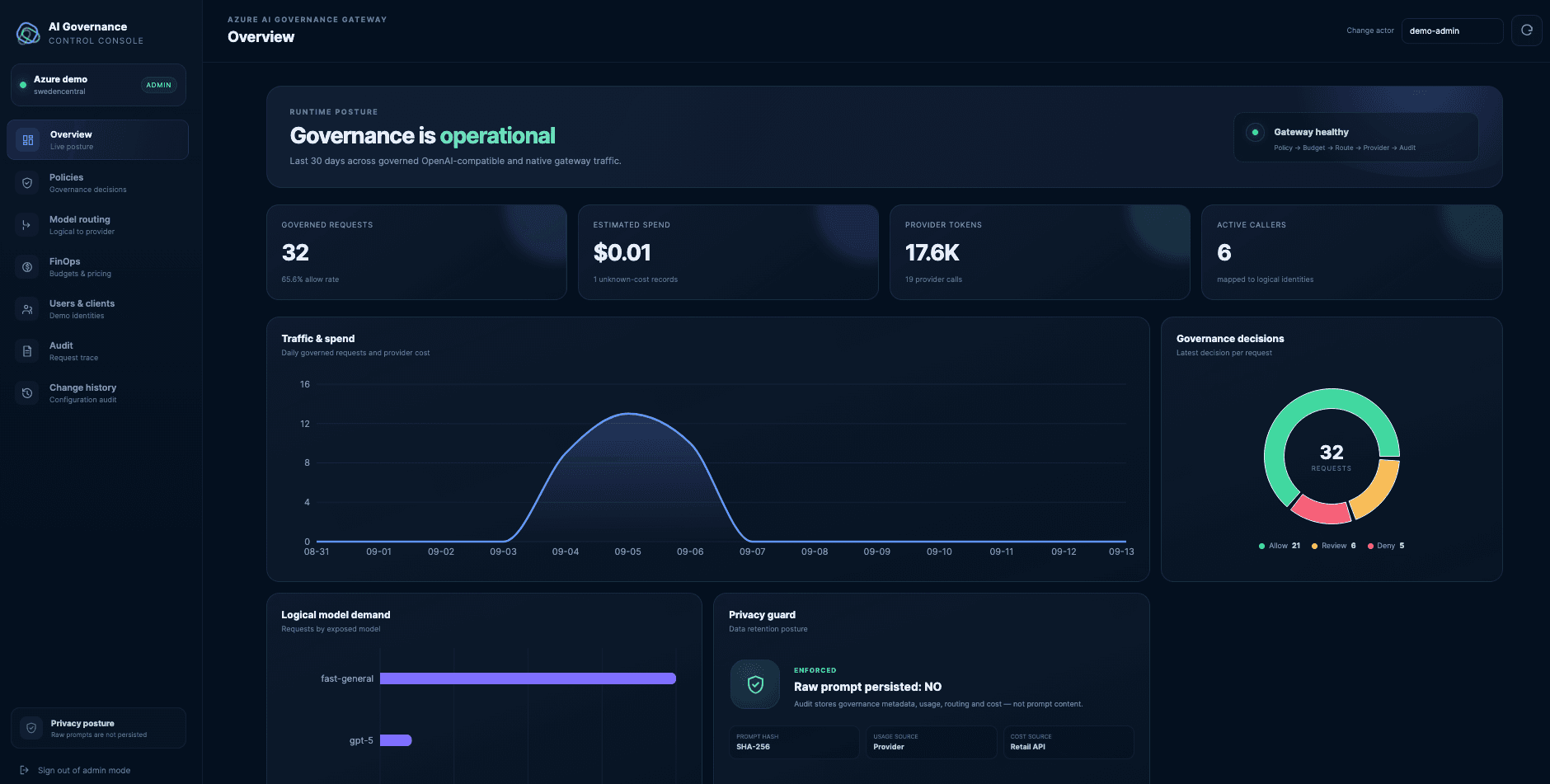
The implementation covers identity, policy enforcement, budget guardrails, model routing, provider-authoritative usage accounting, FinOps cost estimation and immutable audit evidence. The Azure reference MVP also demonstrates an OpenAI-compatible facade, Microsoft Entra ID and gateway credentials, managed identity to Azure OpenAI, PostgreSQL-backed audit data, and a public read-only Governance Console with protected administrative controls.