Aegis SIEM
Evidence-grounded SIEM and SOC analytics platform for predictive incident detection, risk-based prioritization and controlled preventive response.
Aegis SIEM
Evidence-grounded security operations platform for collecting, correlating and analyzing operational and security telemetry to detect, predict and help prevent incidents before they become material business, financial or information-security losses.
Aegis SIEM is not just a log-monitoring tool. It is an analytical operating layer for modern SOC teams: raw events become persisted detections, dynamic business-risk signals, grounded AI analysis and controlled response actions. I implemented this SIEM pattern in two companies with the objective of reducing the probability and impact of serious incidents, not only reacting to them faster.
From reactive monitoring to predictive incident prevention
Many organizations collect logs, dashboards and point alerts yet still struggle to prevent meaningful incidents. The problem is rarely the amount of data. The gap is the missing analytical layer that connects telemetry, patterns, risk, knowledge and response. Aegis SIEM turns heterogeneous operational signals into explainable security and resilience decisions.
The practical goal is to identify conditions that historically precede account compromise, payment failures, data exposure, cloud misuse or monitoring blind spots, then raise warnings or alerts early enough for preventive action.
Detections with engineering discipline
Detections are formal, versioned and auditable. Threshold, sequence, ratio, anomaly and absence logic replaces opaque intuition.
Business-risk linkage
Alerts map to risks such as account takeover, payment degradation, wallet abuse, exfiltration and monitoring blind spots, so prioritization reflects business impact.
Grounded AI, not speculative AI
AI works on top of persisted evidence, policies and historical knowledge. It interprets and explains detections; it does not invent them.
A bridge between the SOC and the business
A mature SIEM does not live only inside the security team. It directly supports:
From IT security foundations to an integrated SOC
Security maturity grows from basic IT protection, through systematic governance and controls, to an integrated Security Operations Center (SOC). At the advanced stage, the SOC becomes the operating model that brings people, processes and technology together; SIEM is its central evidence, correlation and analytical layer.
Integrated SOC and business-aligned security operations
At this level, SOC is broader than any single tool: it combines analysts, repeatable response processes and an integrated technology stack. SIEM provides the central evidence and correlation layer, while SOAR, DLP, UEBA/XDR, EDR/NDR, threat intelligence, IAM/PAM and incident management extend detection, investigation and controlled response.
Organizational and technical security foundation
Security becomes a managed discipline: policies, controls and repeatable workflows replace ad-hoc heroics.
Security as a subset of IT
Essential protection is handled by IT, but operations remain mostly manual and reactive.
How the analytical engine works
The most important part of the solution is not the dashboard. It is the evidence chain that turns raw telemetry into preventive operational decisions.
Raw telemetry ingestion
Events arrive from cloud and infrastructure logs, applications, audit trails, endpoints, payment systems and wallet/provider integrations.
Normalization and enrichment
Events are mapped to a common schema: who did what, from where, against which entity, with what result and in which system. Source, severity, tenancy, service and timing context are added.
Deterministic detection methods
Versioned rules evaluate thresholds, sequences, ratios, anomalies and absence conditions to identify brute-force attempts, privilege patterns, payment degradation, unapproved changes, data-export signals and telemetry blind spots.
Risk lineage and prioritization
Detections link to business-facing risk objects. Risk scores evolve as evidence accumulates, allowing incidents to be prioritized by likely impact rather than technical noise.
Grounded AI analysis
The AI layer receives alert evidence, related events, linked risks, relevant policies, runbooks and historical cases. It produces an analyst summary, interpretation, verification steps, containment suggestions and escalation notes without creating detections on its own.
Alerts, warnings and actions
Alerts are persisted when rule conditions are met; warnings flag a dangerous pattern before the critical threshold; approved actions can be handed to orchestration connectors when policy allows.
The condition has been met
A rule reached its detection threshold. The alert is persisted, evidence-backed and traceable to its rule and linked risk.
A dangerous pattern is forming
The pattern is concerning but has not yet crossed the critical threshold. This is the window for preventive action.
Controlled response
When policy allows, approved actions are handed off through orchestration and AI/MCP-compatible connectors.
AI/MCP actions and preventive response
In advanced operating models, approved actions can be handed to external control systems through orchestration and MCP-compatible connectors. Typical examples include:
The key principle is that actions are policy-bound, explainable and evidence-grounded. AI is not an unconstrained decision-maker; it operates within approved controls, escalation rules and human-governed response patterns.
Incidents rarely come from a single event
They emerge as patterns: too many failures, a suspicious action sequence, a growing error ratio, a deviation from baseline, or telemetry that suddenly disappears. Five rule types cover these cases.
Threshold
Too many events of one kind within a time window, such as repeated authentication failures.
Sequence
A suspicious order of actions, for example a privilege change followed by data export.
Ratio
A growing share of failures, such as an elevated payment-provider error ratio.
Anomaly
A deviation from the learned or defined baseline of normal behavior.
Absence
Expected telemetry stopped arriving, creating a monitoring blind spot.
Risk lineage: from signal to business risk
Every detection is linked not only to an alert but to a risk object. Evidence accumulates, dynamic risk scores update and investigation priorities become business-aware.
From the control tower to the evidence behind a decision
Each view exposes a specific part of the operating model. Click any screenshot to open the original full-resolution image.
 Open full-resolution screenshot ↗
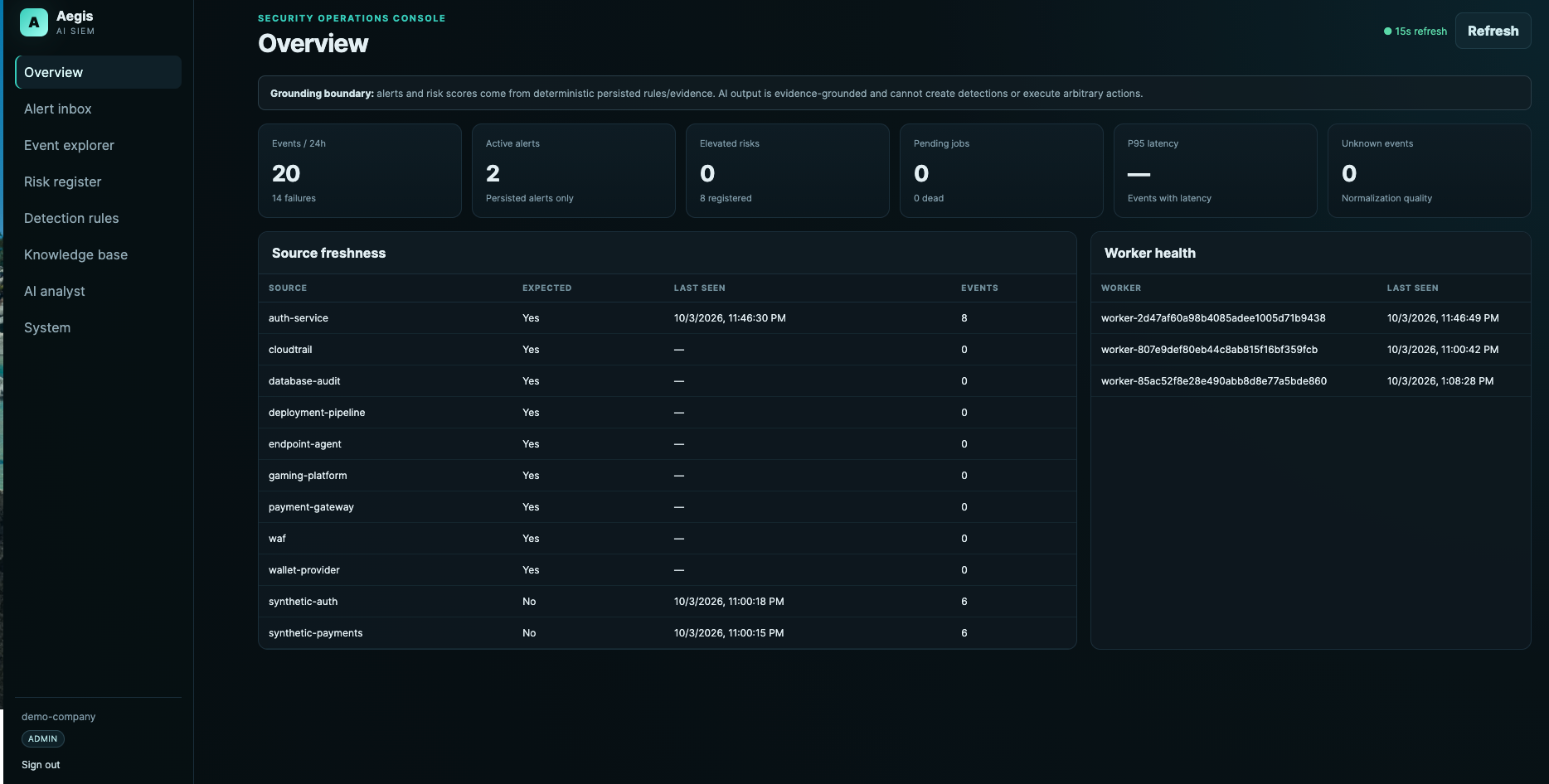
Overview
The executive and operational entry point: event volume, active alerts, risk posture, queue health, latency, source freshness and worker status.
- Shows whether telemetry is flowing as expected
- Highlights active persisted alerts
- Exposes source silence and operational blind spots
- Confirms worker health across the processing pipeline
 Open full-resolution screenshot ↗
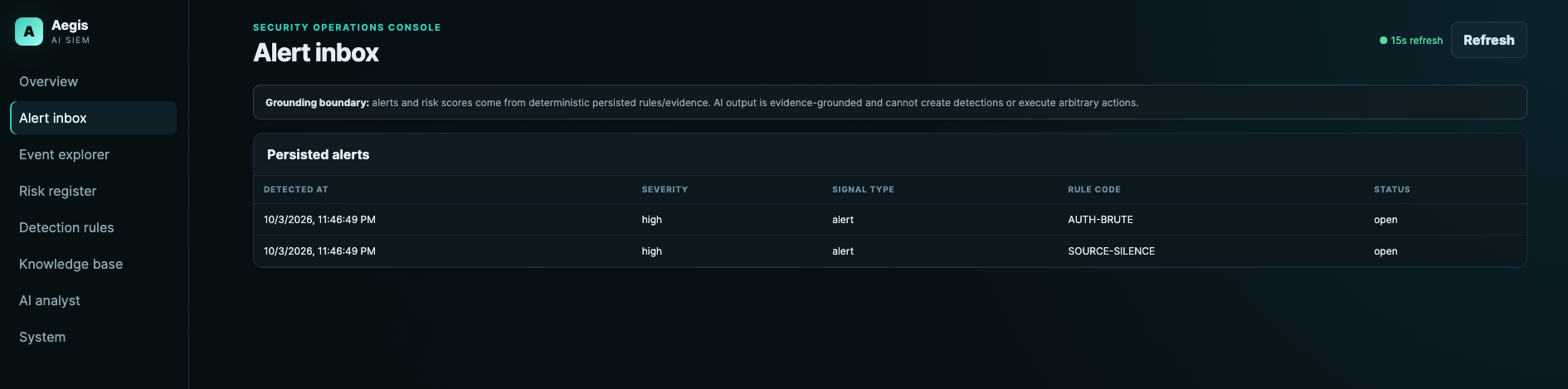
Alert Inbox
Persisted, evidence-backed detections created by deterministic rules and correlation logic. Raw signals become traceable security cases.
- AUTH-BRUTE: repeated failed authentication and a possible account-takeover precursor
- SOURCE-SILENCE: an expected source stopped reporting
- Severity, rule code and status support triage and escalation
 Open full-resolution screenshot ↗
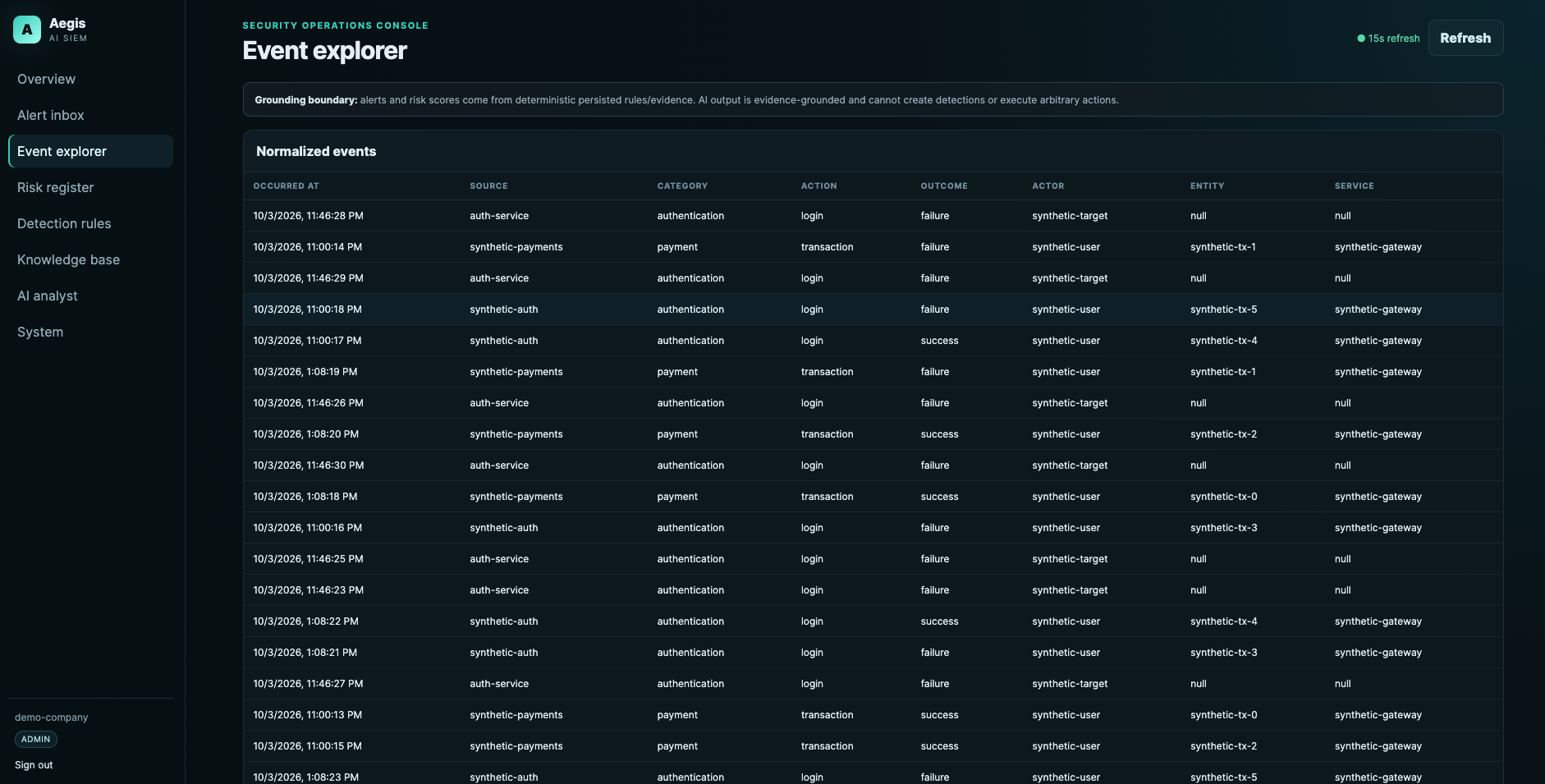
Event Explorer
Normalized events expose source, category, action, outcome, actor, entity and service in a consistent investigation format.
- Accelerates triage and root-cause review
- Creates one schema across heterogeneous sources
- Provides the foundation for correlation and predictive detections
 Open full-resolution screenshot ↗
Risk Register
Technical detections are mapped to business-relevant risk objects and dynamic scores instead of stopping at an isolated alert.
- Tracks risks including account takeover, audit blind spots, wallet manipulation, exfiltration and payment degradation
- Updates dynamic scores from evidence and recurring patterns
- Supports business-aware prioritization
 Open full-resolution screenshot ↗
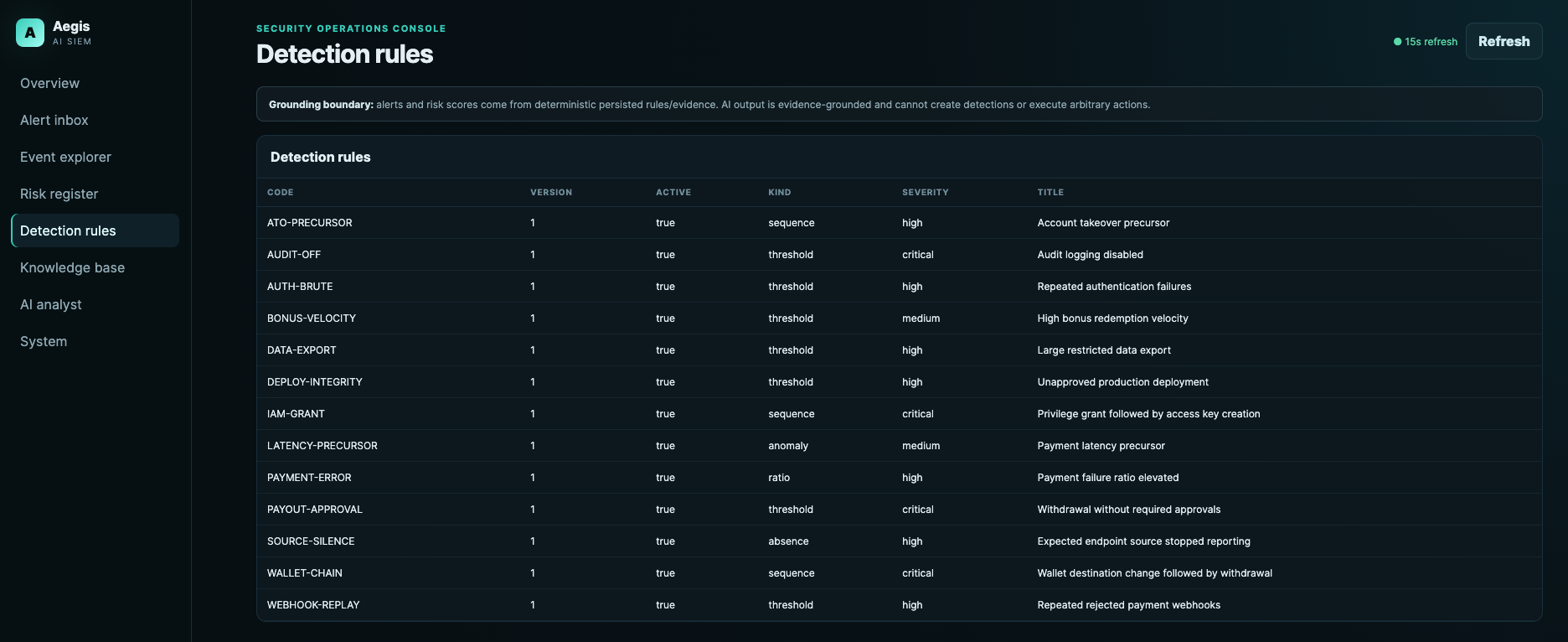
Detection Rules
The formal, versioned and auditable rule catalog is the engineering core of the SIEM.
- Threshold, sequence, ratio, anomaly and absence rules
- Explainable detection behavior
- Safe governance and evolution of detection logic over time
 Open full-resolution screenshot ↗
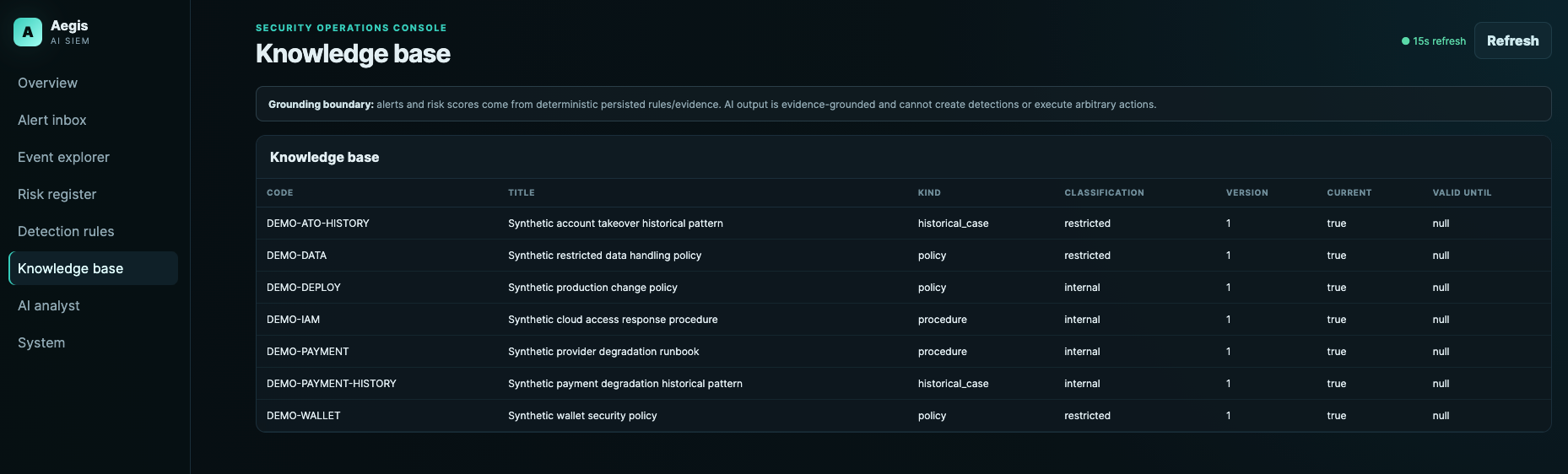
Knowledge Base
Structured internal knowledge grounds the analytical layer in policies, procedures, runbooks and historical cases.
- Guidance for account-takeover suspicion and payment-provider degradation
- Policies for restricted data handling
- Historical cases that add organization-specific context
 Open full-resolution screenshot ↗
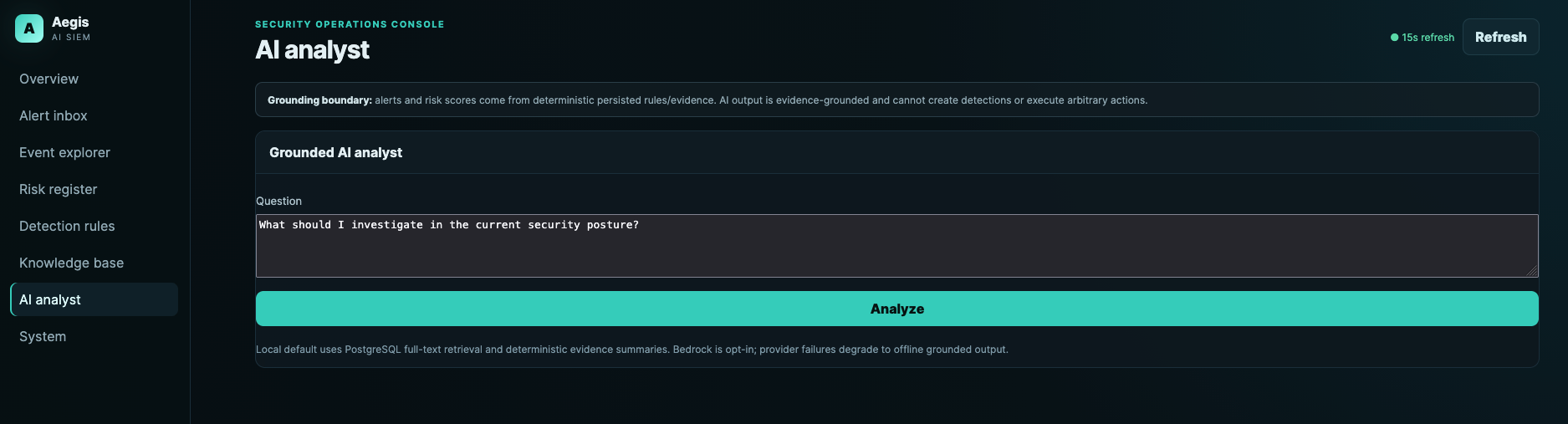
AI Analyst
The analyst interface turns persisted evidence and retrieved knowledge into a grounded investigation aid rather than an autonomous detection engine.
- Answers questions about the current security posture
- Uses deterministic evidence summaries and retrieved knowledge
- Provider failure can degrade to offline grounded output instead of inventing facts
 Open full-resolution screenshot ↗
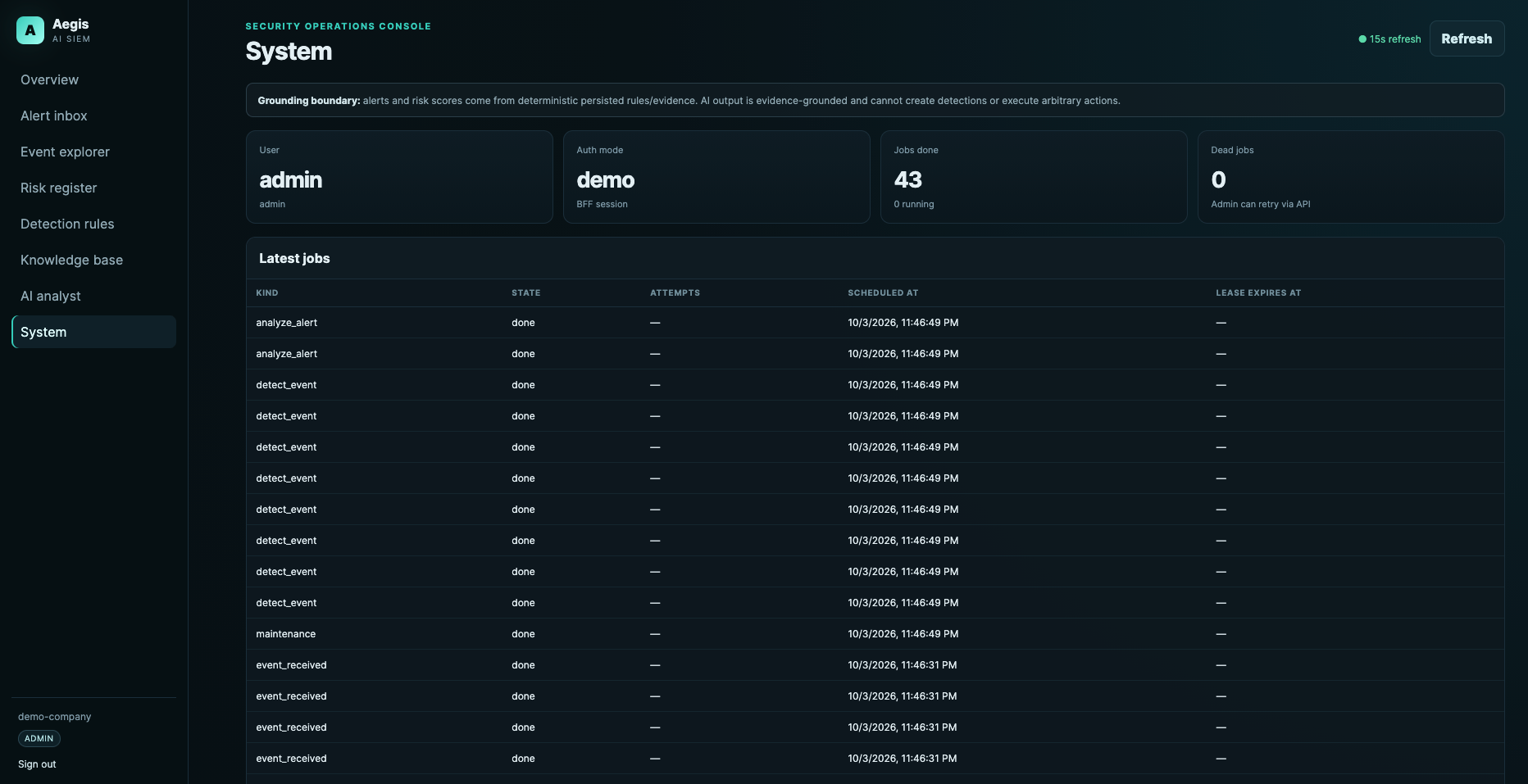
System
Operational observability for the SIEM itself: current user and auth mode, jobs processed, queue health, latest jobs and background-processing state.
- Confirms ingestion, detection and AI-analysis jobs complete
- Supports troubleshooting and operational assurance
- Makes the security platform itself observable
What this changes for the organization
Better anticipation
Weak signals and dangerous patterns can be investigated before they become severe incidents, creating more time for preventive controls.
Less noise, more context
Alerts are connected to risks, knowledge and evidence, turning generic notifications into operationally meaningful decisions.
Reduced loss potential
Telemetry, risk scoring, grounded AI and controlled actions help reduce the probability and impact of security, data and financial-loss events.
Implementation highlights
- CloudWatch / raw-telemetry ingestion and normalization
- PostgreSQL-backed operational data model
- Deterministic rules engine with persisted alerts
- Risk lineage and dynamic risk scoring
- Knowledge base and retrieval-augmented analytical layer
- Grounded AI analysis for analyst support
- Next.js security console for SOC and management workflows
- Containerized deployment path with AWS-oriented architecture
Security operations with prediction, explanation and controlled action
Aegis SIEM demonstrates how a modern SOC capability can evolve from passive monitoring to active, business-aligned incident prevention. Deterministic engineering, risk intelligence and grounded AI help an organization see more clearly, act earlier and reduce the chance of serious outcomes.